Better Comfort, Lower Bills: Modernising Loft Insulation
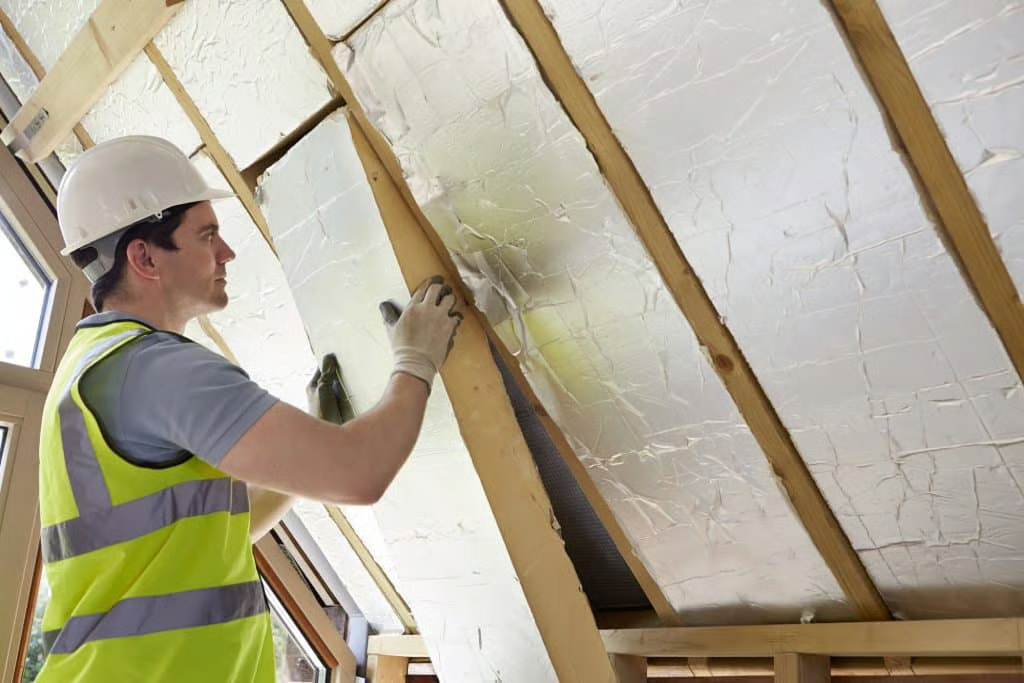
Many people believe that loft insulation is a “fit and forget” modification. In actuality, insulation performance might deteriorate before the material becomes obviously deteriorated. Changing regulations, better insulation technologies, and the natural impacts of time and loft conditions all contribute to ageing insulation becoming less efficient than planned. That is why loft insulation removal can be a cost-effective step rather than a needless outlay. Whether your loft is currently stuffed with layered rolls, loose fill, or older batts, there are compelling practical reasons to remove the old material and replace it with contemporary insulation that works as intended.
The first reason is that insulation compresses and settles with time. Lofts have temperature changes that cause materials to slide, and many forms of insulation degrade when stepped on during storage or accessed for maintenance. Insulation that has been pressed down, displaced to the side, or redistributed with small gaps might leave areas of the roof space undercovered. As covering becomes uneven, heat loss increases. Loft insulation removal resets the insulation depth and restores a uniform layer throughout the loft, including difficult edges like hatch entrances, loft ladders, and services.
A related concern is that obsolete insulation may no longer match modern performance standards. The standards for thermal efficiency have evolved. Even if your current insulation feels quite warm when you enter the loft, its true thermal value may be lower than what newer materials can achieve. By removing old material and performing loft insulation removal, you can install higher-quality insulation with superior thickness and performance characteristics. The idea is not simply to “add more” insulation, but to ensure that the loft is properly insulated, with fewer thermal flaws that might damage efficiency.
There is also the issue of dampness. Lofts are not designed to get wet, but condensation can happen, especially if ventilation is poor or warm, moist air from the living space rises into the roof space. When moisture is present, older insulation loses its efficiency and, in some situations, develops smells or becomes mould-prone. Even if visible dampness is not immediately apparent, insulation can absorb moisture at the microscopic level, diminishing its insulating capabilities. Loft insulation removal is necessary since simply replacing broken or damp insulation may not address the underlying issue. New insulation works best when installed in dry, stable conditions.
The apparent goal is to save energy expenses, but additional advantage is increased comfort throughout the home. Poorly functioning insulation causes rooms below the loft to cool down in the winter and overheat more quickly in the summer. A properly insulated roof area helps to reduce these extremes. If your current insulation is old, inconsistent, or has been damaged by compression or moisture, loft insulation removal and replacement can help eliminate drafts and promote a more equal indoor temperature. Many homeowners have noticed that bedrooms and upper rooms are simpler to heat and less prone to cold spots, particularly near ceilings and upper walls.
There’s also the issue of gaps and air leaks. Insulation is simply a part of the heat loss equation. Warm air can leave through holes in the ceiling and around penetrations, while outside air can enter through open spaces. Older systems may have left minor gaps around plumbing, wiring, loft hatches, and where the ceiling meets the rafters. These flaws allow air movement, which degrades insulating performance. When loft insulation removal is performed, the entire insulation arrangement is effectively reset, and gaps and sealing details can be addressed more thoroughly. A replacement process might provide more than just a “swap”: it can be an opportunity to improve how the insulation connects with the rest of the roof space and ceiling structure.
Loft insulation removal can help with safety and housekeeping issues. If your loft has old or defective insulation, it could include dust, debris, or deteriorated materials that are no longer stable. Some older insulation has been disturbed due to DIY projects, previous maintenance access, or animals breeding in the loft. Even when the material is not visibly broken down, it might be untidy or difficult to work with. Removing it permits the loft to be fully cleared, inspected for vermin or droppings, and ready for the clean installation of new insulation. A clean and prepared loft allows the replacement system to function effectively and lowers the possibility of future issues.
Another factor to consider is age. Insulation installed decades ago may have lost its original structure due to regular wear, vibration, and exposure to changing temperatures. Certain materials can shrink or become spotty. Others may create air ducts that allow heat to escape more quickly. Over time, your insulation layer will become less continuous. Loft insulation removal provides a clean baseline for measuring depth and coverage, ensuring that the new insulation is properly installed and maintained where it should be.
If your house has been enlarged, renovated, or had the loft partially converted, the insulation may be inconsistent. For example, a previous refurbishment may have added insulation in one place while leaving older material in another. These mismatched layers can form thermal bridges or hotspots, where heat losses are most prevalent. In some cases, topping up might exacerbate the situation by causing uneven levels or leaving gaps between old and new parts. Loft insulation removal helps to standardise the insulating layer across the entire roof area, resulting in uniform thermal performance from one end of the loft to another.
There is also the issue of roof repair and upkeep. If you are already planning work in the roof space, such as improving ventilation, repairing leaks, or replacing roof membranes, loft insulation removal becomes even more rational. It provides access to the regions that require attention while keeping the insulation from becoming contaminated during repairs. Removing old insulation first can expose hidden problems such as minor wet patches, broken felt, or locations that require ventilation adjustments. In other words, loft insulation removal can serve as both a diagnostic and an upgrade.
Modern insulation systems may include features that provide additional benefits. For example, modern materials may be easier to install at the proper depth and decrease voids more effectively. Some items are engineered to be less prone to settling, allowing them to operate better over time. When homeowners replace outdated insulation with modern options, they typically increase not only the thermal value but also the ease of reaching and maintaining enough covering. Loft insulation removal allows you to benefit from these benefits rather than depending on deteriorating insulation.
Another significant argument is that ageing insulation may limit future alternatives. If you intend to store more objects in the loft or convert a portion of the loft into usable space, insulation must be strong and correctly installed. Poorly installed or old insulation can make it difficult to maintain a consistent thermal barrier, and it is more likely to become disturbed and compacted as you move around. You can establish a solid insulation base that can withstand regular maintenance access by executing loft insulation removal and replacement.
It is worth noting that loft insulation removal can help to achieve environmental aims. Heating demand effects both energy use and carbon emissions. Improving insulation efficiency lowers the amount of heat required to maintain comfortable indoor temperatures. When the replacement is done properly, the reduced heat loss implies your heating system will run less frequently or at a lower output. This translates to fewer fuel use over time. While the immediate motive is often cost and comfort, many homeowners appreciate the long-term environmental benefits of a more efficient home.
Of course, the choice to remove old insulation should be made after a thorough examination of its current state. If your insulation is reasonably new, dry, and in excellent shape, you may not require complete removal. However, if it is old, uneven, compacted, moist, or plain underperforming, replacement can provide significant benefits. Loft insulation removal is especially useful when there is evidence of dampness, stains, musty odours, or apparent deterioration. In some circumstances, upgrading insulation not only improves efficiency but also prevents persistent moisture-related concerns that can lead to worse problems in the future.
Finally, consider the cumulative effect. Heat loss via the roof can be significant, and slight inefficiencies compound up over time. Even if your current insulation appears “good enough,” older materials may have lost performance in ways that are difficult to detect without extensively inspecting coverage and conditions. Loft insulation removal and replacement provides a clean reset: new insulation put to the proper depth, with increased coverage, integrated sealing, and consistent performance. That is how you transition from unpredictable thermal comfort to consistent efficiency.
In conclusion, the reasons for loft insulation removal and replacement are practical, quantitative, and frequently noticeable in day-to-day comfort. Ageing, compression, gaps, moisture danger, uneven covering, and changing standards all suggest to upgrading rather than using older insulation. When old material is removed and new insulation is properly placed, the benefits go beyond lower energy bills. They include a more stable home temperature, better roof space conditions, and a more solid long-term foundation for keeping a comfortable, efficient house.