Performance and Reliability in Deep Groove Ball Bearings: A Focus on SKF 16005
Given their adaptability, effectiveness, and dependability in many contexts, deep groove ball bearings rank high among the rolling-element bearings utilised in contemporary engineering. Recognising that a particular reference, like SKF 16005, denotes a certain size, load capacity, and performance expectation within the larger family of deep groove ball bearings is fundamental to comprehending these components. These bearings are ideal for electric motors and agricultural machinery due to their ability to handle mild axial loads in both directions and radial loads. Deep groove ball bearings are well-liked because of their straightforward construction, which permits reduced friction, fast functioning, and little upkeep. In difficult mechanical conditions, deep groove ball bearings are renowned to deliver a balance between compact dimensions and dependable service life, which is exactly what engineers are often looking when they specify a bearing like SKF 16005.
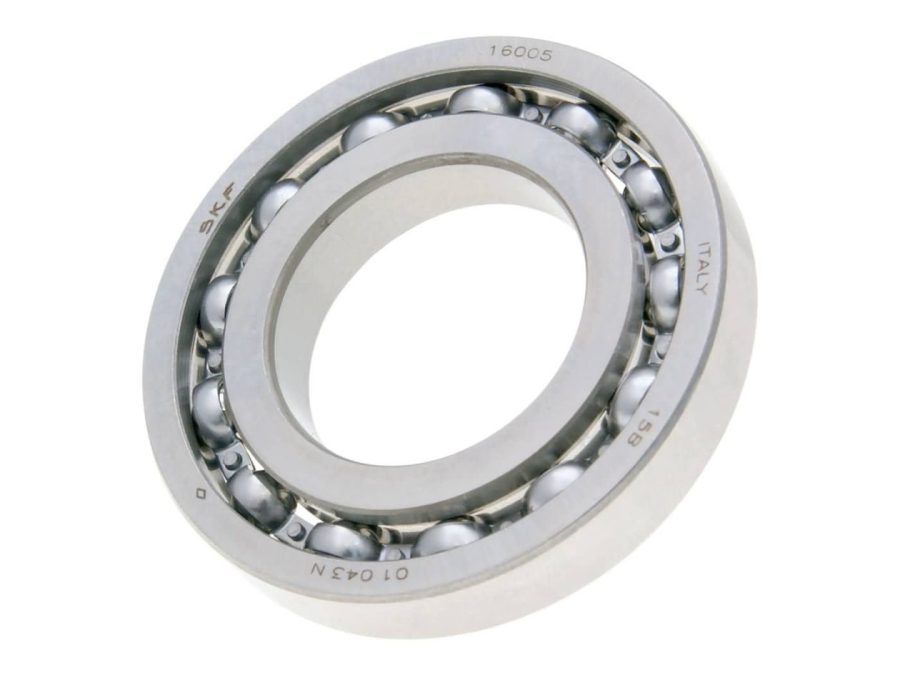
The performance of deep groove ball bearings can be understood by examining their basic construction. Designations like SKF 16005 aid in identifying these details. A bearing is made up of an inner ring, an outer ring, a cage that equally spaces the balls, and a set of precision balls. Supporting combined stresses and ensuring smooth rotation, the bearing is made possible by the deep raceway grooves on both rings, which precisely match the balls. The groove geometry of the SKF 16005 is designed to disperse loads evenly throughout the rolling elements and minimise stress concentrations. Applications that prioritise efficiency and noise control would benefit greatly from this design’s contribution to quiet running and reduced vibration. The internal geometry of a bearing, such as the SKF 16005, allows designers to make educated decisions on the bearing’s suitability for various operating conditions.
The performance and longevity of deep groove ball bearings are greatly affected by the materials used to make them. The standard specified by SKF 16005 shows that metallurgy was carefully considered. To obtain the ideal combination of hardness and toughness, bearing rings and balls are usually made from high-quality bearing steel that has been heat treated. That way, it won’t distort, wear out, or wear down when put under stress. To provide dimensional stability over extended periods of service, bearings like the SKF 16005 have material qualities that are matched to the anticipated operating stresses. Consistent ball guidance is achieved in part because the cage material is chosen according to the needs for speed and lubrication. The continued reliability of deep groove ball bearings in both industrial and light-duty machinery is largely attributable to these material selections.
The SKF 16005 designation gives engineers insight into the load-carrying capability, which is one of the defining factors when selecting deep groove ball bearings. The radial loads are the primary focus of deep groove ball bearings, but the axial loads in either direction can be accommodated by the curved raceways. Due to their dual functionality, they are highly appealing for compact designs that have limited capacity for separate thrust bearings. The SKF 16005 bearing is designed to withstand a combination of loads reliably, without overheating or wearing out too quickly, in applications where it is required. It is crucial to correctly select a deep groove ball bearing from the family because engineers can more precisely forecast performance and save expensive downtime if they understand the relationship between load ratings and bearing life.
Another area where deep groove ball bearings shine is in speed capability. SKF 16005 is often linked to applications that demand smooth operation at reasonably high rotational speeds. Energy loss is minimised in motors, pumps, and fans due to the reduced friction that is inherent in the rolling contact between balls and raceways. Lubrication improves its performance even further by lowering the friction between metal parts and releasing excess heat. Consistent performance with little noise and vibration is possible when using an SKF 16005 within its suggested speed limitations. Since the efficiency and precision of rotation are paramount in precision equipment, deep groove ball bearings are an ideal choice. One of the main reasons for their extensive use is that they can work quickly without compromising on durability.
Deep groove ball bearings, such as the SKF 16005, are very susceptible to the effects of improper installation and handling on their service life. Proper mounting guarantees the intended distribution of loads and the maintenance of internal clearances. Bearing life might be reduced due to strains introduced during installation by misalignment or excessive force. To get the most out of your SKF 16005, make sure to pay close attention to the shaft and housing tolerances. Contaminants can harm the raceways and rolling elements, thus it’s important to be clean when installing them. The importance of thorough preparation and handling is emphasised when engineers follow correct processes to guarantee that deep groove ball bearings perform to their maximum reliability and lifespan potential.
Deep groove ball bearings rely on proper lubrication for optimal performance, and SKF 16005 performance is closely related to this. Lubricating the moving parts with grease or oil forms a barrier that prevents wear and friction between the raceways and the rolling elements. Considerations including operating temperature, load, and speed dictate the lubricant to use. Keeping SKF 16005 bearings in good working order and avoiding problems like corrosion and overheating is as simple as using the right lubricant and relubrication intervals. Modern machinery frequently requires minimal noise, and proper lubrication helps achieve this goal. Therefore, while specifying and maintaining deep groove ball bearings, it is vital to understand lubrication principles.
Like all deep groove ball bearings, SKF 16005 performance can be severely affected by environmental factors. Water, dust, or chemical contaminants, if not controlled, can hasten wear and eventually cause failure. To keep impurities from getting into the bearing, you can use sealing solutions and make sure the housing is designed properly. Bearing life is impacted by temperature fluctuations because of their effects on lubricant behaviour and material qualities. These considerations are crucial for making an appropriate selection of SKF 16005 for a given setting. Engineers can maximise the dependability of deep groove ball bearings in various working situations by taking environmental factors, load requirements, and speed requirements into account.
Understanding the operating circumstances is crucial for developing maintenance plans for deep groove ball bearings. The use of SKF 16005 indicates a preference for low-maintenance operation. To catch problems early, check for changes in temperature, vibration, and noise levels on a regular basis. In order to decrease unscheduled downtime, predictive maintenance approaches enable planned intervention prior to failure. Regular maintenance is essential for bearings such as the SKF 16005 to keep them running smoothly and efficiently for a longer period of time. Deep groove ball bearings are durable by design, but proactive monitoring is still necessary to make sure they keep up with operational demands over time. This shows how important it is to include bearing care in overall maintenance programs.
Deep groove ball bearings, with designations like SKF 16005, are useful in many different fields and applications, demonstrating their adaptability. All sorts of spinning components rely on these bearings, from heavy machinery to everyday appliances. Many engineers use them because of their small design, high speed capability, and ability to handle heavy loads. A specification for an SKF 16005 deep groove ball bearing is a vote of confidence in the bearings’ tried-and-true design principles. These bearings show that reliability can be achieved through a combination of simplicity and accuracy, and they are an essential part of mechanical design even as technology advances.