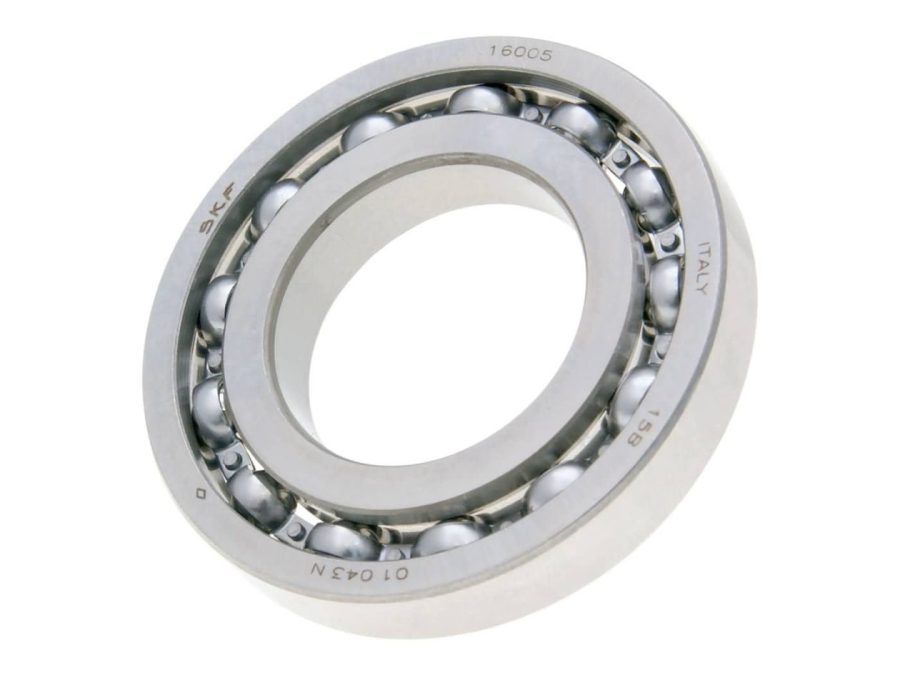
Performance and Reliability in Deep Groove Ball Bearings: The SKF 6312C3 Perspective
The adaptability, efficiency, and dependability of deep groove ball bearings make them a top choice for a wide variety of applications in contemporary machinery. Their capacity to withstand axial and radial loads with little friction is based on a basic yet exquisite design, which is the core of their popularity. In order to demonstrate the practical application of this sort of bearing, it is typical to mention a product reference like the SKF 6312C3. This reference stands for a common size and clearance idea. In applications where uninterrupted rotation and extended lifespan are critical, such as electric motors, pumps, gearboxes, and home appliances, deep groove ball bearings are utilised. Designs such as the SKF 6312C3 have stood the test of time because they demonstrate how a well-engineered bearing can be both simple to build and fulfil extremely high performance standards.
The geometry of the raceways closely matches the curvature of the balls, defining a deep groove ball bearing. Because of its deep groove, the bearing is able to withstand moderate axial loads in either direction and substantial radial loads, making it very versatile. To avoid bearing overheating, engineers often use the designation SKF 6312C3. This type of bearing has an internal clearance that can withstand greater working temperatures or snugger fittings. The design minimises wear and noise by distributing loads uniformly and minimising contact stress. When you know how the deep groove profile works, you’ll see why SKF 6312C3 bearings are so popular for uses that need steady performance and constant rotational accuracy for long periods of time.
To what extent deep groove ball bearings function depends on the quality of the materials and the craftsmanship that went into their production. For the required hardness, fatigue resistance, and dimensional stability, high-grade bearing steel is often utilised. The material choice for the SKF 6312C3 bearing guarantees that it will not degrade in the face of repeated stress cycles. Accurately sized rolling elements and smooth raceways are the direct result of precision production, which in turn affects friction levels and heat generation. Tolerances must be very close because even little changes might have an impact on performance. The consistent performance of bearings like the SKF 6312C3 shows how controlled production procedures and material science work together to provide dependability in harsh industrial settings.
A deep groove ball bearing’s internal clearance affects its load distribution, temperature behaviour, and operating life, making it an important performance component. If thermal expansion or press fitting could diminish running clearance, the clearance designation for SKF 6312C3 would be a good choice because it shows a greater than typical internal clearance. Because of this quality, ideal contact angles are maintained and excessive friction is prevented even when temperatures increase. Picking the suitable clearance is just as crucial as picking the right size, since the wrong clearance can cause failure to happen too soon. Bearing selection and long-term reliability are greatly impacted by clearance concerns, as is demonstrated by the frequent mention of SKF 6312C3 in technical contexts.
Deep groove ball bearings can’t function properly without lubrication, which serves to decrease friction, prevent corrosion, and disperse heat. Keeping a thin film separating rolling elements from raceways is the objective, whether oil or grease is utilised. Proper lubrication procedures aid in the operation of SKF 6312C3 components in applications subjected to varied loads and speeds. Increased temperatures and energy losses can result from both too much and too little lubrication, which is problematic in and of itself. By optimising performance and extending service intervals, maintenance teams may reduce operating costs and enhance equipment availability by understanding the lubrication demands of bearings like SKF 6312C3.
One of the main reasons why deep groove ball bearings are so popular is because of their load capacity and speed capability. Because of their construction, they can easily handle large loads despite their diminutive size while operating at high rotating speeds. When talking about mid-sized bearings that manage load capacity and speed performance well, the SKF 6312C3 tends to come up. These bearings are ideal for uses requiring noise control due to their reduced vibration caused by the smooth raceway geometry. Supporting the machine’s overall integrity, bearings like the SKF 6312C3 keep nearby components safe from unnecessary stress by keeping everything in proper alignment and smoothly rotating.
The efficiency and durability of deep groove ball bearings are greatly affected by how they are installed and handled. The uniform distribution of loads and the preservation of internal clearances are guaranteed by using the correct mounting procedures. Careful application of mounting forces is required when dealing with SKF 6312C3 to prevent raceways and rolling elements from being damaged. Impure practices during installation can rapidly erode bearing surfaces, hence cleanliness is of the utmost importance. Although SKF 6312C3 is sturdy, it is still important to handle them with care. What this means is that proper installation is just as important as good design when it comes to achieving reliable performance.
The performance of bearings can be impacted by several operating conditions, including temperature, pollution, and vibration. Although deep groove ball bearings can withstand most situations with little to no maintenance, they do demand careful consideration when choosing and using them in extremely harsh settings. The higher internal clearance of the SKF 6312C3 bearing allows it to reliably perform at elevated temperatures by accommodating thermal expansion. This feature is commonly brought up in talks about the bearing. Another factor in keeping impurities out of the bearing is the sealing system and the lubrication option. Users can guarantee that a bearing, such as the SKF 6312C3, performs predictably throughout its service life by taking the complete operating context into account.
The goal of deep groove ball bearing maintenance is to discover problems early on and fix them before they fail. The earliest indications of wear or lubrication failure can be found through routine inspection, vibration analysis, and temperature monitoring. Preventative maintenance like this helps keep SKF 6312C3 equipment running smoothly and save money on repairs. Timely bearing replacement protects adjacent components and keeps the system running smoothly. References like SKF 6312C3 are commonly used in maintenance planning, which shows how standardised bearing types make technical decision-making and inventory management easier.
The simplicity and good performance of deep groove ball bearings are the reasons for their ongoing appeal. Their efficacy in innumerable applications is a result of every facet of their construction, from materials and design to installation and upkeep. One practical example of how a well-specified bearing may handle different operating demands is the frequent mention of SKF 6312C3 in technical discussions. Engineers and technicians can improve dependability, efficiency, and longevity by making informed choices based on their understanding of the concepts behind deep groove ball bearings. Thus, the vital role that bearings like the SKF 6312C3 play in contemporary mechanical systems is further demonstrated by their ongoing significance.